
Free SEO Audit in Nepal — A Real Review of Your Site, Not a Tool Report
If your website isn’t bringing in enquiries, there’s a reason, and it’s usually findable in an afternoon. I’ll go through your site and your Google listing myself and send you a plain-language summary of what’s holding you back — back to you in two to three business days, free, with no obligation afterwards.
I’m Prakash Kushwaha, and I do the audit personally. That’s not much of a claim any more; half the people offering an SEO audit in Nepal say the same thing and some of them mean it. So the rest of this page is the part nobody shows you: what you actually receive, what I find most often on Nepali sites, when you need the paid version instead, and what an audit genuinely can’t tell you.
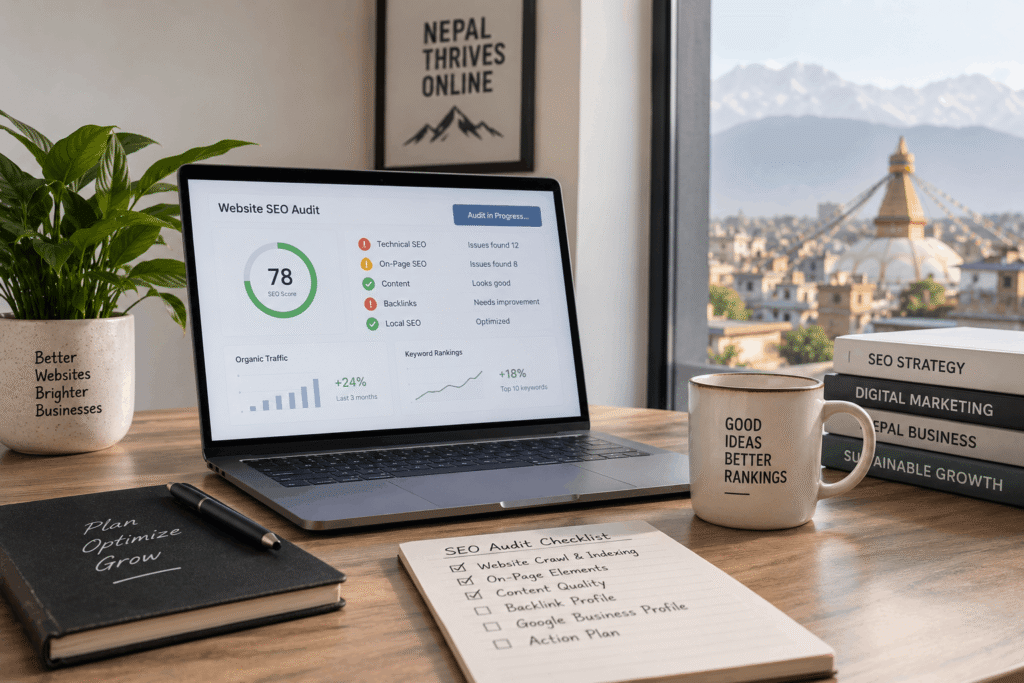
What you actually receive
Something odd turned up while I was researching this page. In September 2026 I read sixteen pages ranking for an SEO audit in Nepal and its close variants — service pages, tools and guides alike. Not one of them shows you the deliverable.
They describe it. One promises a report “with screenshots, issue severity labels, recommended fixes, and before/after metrics” and displays none of those things. Another refers to a hundred-point scorecard without publishing a single line of one. Two show Google Search Console graphs, which prove a result rather than an audit. The rest show an icon.
You’re being asked to hand a stranger access to your website on the strength of an adjective. So here’s a real extract, and the site being audited is mine.
Audit extract — prakashkushwaha.com.np, September 2026. My own site.
1. No H1 on five of seven pages. Each page’s visible headline was marked up as an H2, leaving no single statement of what the page was about. Cause: the heading widget’s HTML Tag dropdown defaults to H2 and nobody had changed it. Fix: one dropdown per page. Status: fixed.
2. No structured data on four pages. No Service, FAQPage or BreadcrumbList output, on pages that carried an FAQ and an offer and declared neither. Status: mostly fixed — two pages still outstanding.
3. Template placeholder text published as fact. A statistics bar left over from the theme, carrying impressive numbers that belonged to nobody, sitting live beneath a headline. Fix: delete. Priority: today. Status: fixed.
4. Header and footer templates indexed as separate pages, competing with the real pages for the same terms. Status: fixed.
5. A link to a 404 on the site’s most commercially important page — a guide that had been written but never published. Status: fixed.
That’s the format: each item with what it is, what caused it, what it takes to fix, and — because an audit nobody acts on is just a document — where it got to. Five things, not forty pages. If your site has three real problems you’ll get three, because padding a report to look like value is how people end up buying work they didn’t need.
Publishing my own audit isn’t a stunt. It’s the only sample I can show without asking a client’s permission first, and it demonstrates the thing that matters when you’re choosing who to let near your website: I’ll tell you what’s wrong even when it’s embarrassing to say it.
The five things I find most often on Nepali business websites
Every audit page in this market lists the same technical categories — crawlability, Core Web Vitals, robots.txt, structured data — because they’re lifted from international SEO writing. That describes what a piece of software checks. It doesn’t describe what keeps going wrong on Nepali business websites, which is a shorter and more useful list.
Roughly in order of how often I run into them:One page asked to sell everything the business does
A facility company offering carpet cleaning, pest control, marble polishing, janitorial contracts and gardening puts all of it on a page called "Our Services." That page then has to answer a dozen different searches at once, and Google resolves the ambiguity by ranking it for none of them. Pulling it apart is dull work with a disproportionate payoff, and it's often the first thing I recommend.
A Google Business Profile that's unclaimed, half-built, or filed under the wrong category
A beauty parlour filed as "Spa" doesn't appear for "hair salon near me." A training institute filed as "School" vanishes from every course search in its own neighbourhood. The listing looks fine to its owner, which is exactly why it goes unnoticed for years.
Keyword plan
A keyword plan written entirely in English for customers searching in three languages. More on that below, because it's the check nobody else in this market runs.
Photographs uploaded straight off a phone, four megabytes each
The site feels quick when you check it — you're on the office connection, and the images are already cached in your browser. Your customer is on a bus at Gongabu with two bars of signal, waiting nine seconds for a hero image. That's a ranking problem before it's ever a design problem, and it's the cheapest thing on this list to fix.
Nothing in Search Console
Either it was never set up, or it lives in a web developer's personal account and nobody has opened it since launch. The answer to "why aren't we ranking" is often already sitting in there, unread, for free.
None of these are exotic, and that’s the point. Most Nepali business sites don’t have a subtle problem. They have two or three obvious ones that nobody has pointed at. Which of them hurts most depends on what you sell — I’ve written up how search behaves across seven industries if you want to see where yours sits.
What I check
Five areas. I open the site and work through them myself, in this order, because each one changes what’s worth looking at in the next.
Technical health
Whether Google can crawl and index your pages at all, what the site does on a phone over mobile data, redirect and status-code problems, whether your sitemap and robots file agree with one another, and whether anything is quietly blocking a page you care about. This is the part of a site you can't judge by looking at it, which is precisely why the expensive problems hide here.
Structure and on-page
What each page is for, whether it says so, and whether two of your pages are competing for the same search. Headings, titles, internal links, and the one-page-per-thing-you-sell question from the list above.
Keyword and language gap
What your customers type, set against what your site currently targets — in English, in Roman-Nepali and in Devanagari. Most audits in this market stop at the first of the three.
Google Business Profile
Claimed, complete, correctly categorised, services listed with prices, photographs current, and reviews still arriving rather than stopping two years ago. If you run a local business, expect this section to be the shortest to read and the quickest to pay you back — it's the one part of the audit that can change what you see in the search results before the month is out.
Competitor snapshot
One or two real competitors. Not a generic industry list: the specific businesses sitting above you for the searches you want, and what they're doing that you aren't.
The check nobody else runs: Nepali and Roman-Nepali search
People here search for the same thing three ways — in English, in Roman-Nepali typed on an English keyboard, and in Devanagari. Someone who needs a plumber might type “plumber in Kathmandu” or “kathmandu ma plumber” or the Nepali equivalent, and which one they pick has more to do with their age and their phone than with what they want.
A keyword plan built on the English third leaves you invisible to the other two, and nobody has told you, because the reports that would have shown it are in English as well.
This isn’t a claim I’m asking you to take on faith. It’s a check with a method, and the evidence is almost certainly already in your own Search Console: Roman-Nepali queries collecting impressions, landing on pages never written for them, converting at nothing because the page answers a different question. I pull that report, sort it by impressions against clicks, and show you the terms you’re accidentally half-ranking for. Usually there are more than the owner expects.
Of the sixteen pages I read, one guide covers Nepali content properly as an implementation question — hreflang tags and URL structure — and one tool lists “Nepali language optimization” as a feature. Neither shows a business owner how to find the gap in their own data, which is the part worth having.
A tool, a free audit, or a paid technical audit — which one you need
Turnaround times in this market run from instant to fourteen days, and the number on its own tells you nothing useful. What it tells you is which of three quite different products you’re being offered.
Instanty results, basic checks
Seconds
Free
Quick automated checks when you want an immediate overview of your site.
- Catches
- Missing tags
- Broken links
- Speed scores
- Basic technical errors
- Misses
- Anything that requires context or judgement
A quick sanity check
A real human review
2 -3 business days
Free
I personally look at the site rather than handing you another automated score.
- Catches
- Website structure
- Google Business Profile
- Search and language gaps
- Important on-page issues
- Competitor visibility
- Misses
- Deep crawl of a large catalogue
Most Nepali small and medium businesses
A real human review
7–14 days business days
Quoted one-off
A much deeper investigation for websites where the problem goes beyond the basics.
- Catches
- Crawl and indexation issues
- Rendering problems
- Large-site architecture
- Crawl budget
- Migration problems
Large sites, e-commerce, a migration that went wrong
Run the tool. It’s free and it takes a minute, and there’s no reason not to. What it can’t do is notice that one page is being asked to sell a dozen services, or that your Business Profile sits in the wrong category, or that a large part of your market is searching in Roman-Nepali. Those need somebody to look.
At the other end, a technical SEO audit in Nepal priced as its own project is legitimate, and it is different work — hundreds of pages, a product catalogue, a site that lost its rankings after a redesign. Two of the sixteen pages I read publish a price for that; the rest say “request a quote,” which is how a buyer ends up comparing three proposals that all say “comprehensive SEO audit” at three different numbers with no way to tell what’s different.
So, mine, published: deep technical audit — from NPR 60,000, one-off. I’ll tell you during the free audit whether I think you need it, and I’ll tell you when you don’t, which is more often. Ongoing monthly work is priced separately on the SEO services page.
What I need from you
Less than you’d think, and you can start with the first line alone.
Your website address
Enough for me to begin.
Read-only Google Search Console access
If you have it. This is the single most useful thing you can give me and also the item most often unavailable, because nobody remembers who set it up. If that's your situation, say so — working out who holds it is part of the audit.
Google Analytics
Read-only, if it exists.
Your Google Business Profile
Or just the business name so I can look at what's public.
I don’t need your website login and I won’t change anything. An audit is a read, not an edit.
What an audit can't tell you
An audit can’t tell you how long it will take to rank, because that depends on what your competitors do next and I can’t see their plans. It can’t fix anything by itself — it’s a diagnosis, and someone still has to do the work, whether that’s me, your developer, or you on a quiet Friday.
And sometimes the finding is that search isn’t your problem at all. If visitors are arriving and enquiries aren’t, the issue is on the page rather than in Google, and no amount of ranking work will touch it. I’ll say so rather than sell you the thing I happen to sell. Same with timing: when you need customers this quarter rather than next, Google Ads is the honest recommendation and this page isn’t.
How it works
You request the audit
Your website and a way to reach you, nothing more.
I review it personally
Two to three business days.
We go through it together
A short call or a written summary, whichever suits you.
You decide what happens next
Fix it yourself, hire me, or hire somebody else. No contract to get the audit, and none appears afterwards
Why it matters who runs it
An audit isn’t a list of errors. Any crawler produces one of those in thirty seconds, and it’ll be technically correct and practically useless, because it weights a missing alt tag the same as a services page that can’t rank.
The work is in the judgement: deciding which three of forty findings are the ones costing you money, which twenty don’t matter for a site your size, and what order to fix them in so that one repair doesn’t undo another. That’s the part that can’t be delegated or automated, and it’s why I do these myself — I’ve spent eight years watching which of these problems actually changes a Nepali business’s enquiries and which just changes its score.
Let’s Grow Your Business
Need more traffic, leads or sales? Tell me what you’re working on and I’ll recommend the right approach — SEO, Google Ads or website improvements.
Questions I get asked
Is it actually free, or is there a catch?
Free. No card, no contract, no useful half withheld until you pay. The only thing I ask for is enough access to review the site properly, and even that’s optional — I can work from the public site alone if you’d rather not hand Search Console to someone you’ve just met.
How is this different from a free SEO audit tool?
A tool checks mechanical things and returns the same shaped report to every website that asks. That’s useful and you should run one. It just can’t exercise judgement, and most of what’s wrong with a small business website needs judgement. Run the tool first if you like; this starts where it stops. There’s a longer piece on separating practitioners from resellers in my guide to hiring an SEO expert in Nepal.
What's the difference between this and a technical SEO audit?
Scope and depth. This covers technical health alongside structure, keywords, your Google listing and competitors — the whole picture, at the depth two to three days allows. A dedicated technical audit goes much further into crawling, indexation, rendering and Core Web Vitals alone, and is what a large or broken site needs. Most Nepali small and medium businesses don’t, and I’d rather say so than sell you one.
Will you pressure me to hire you afterwards?
No, and it would be poor business if I did. The audit exists so we both find out whether there’s a job here. You get the same summary whatever you decide.
Do you need access to my website?
No login, and nothing gets changed. Read-only Search Console makes the audit considerably more useful but isn’t a condition of it.
My website is new. Is it too early for an audit?
It’s the best time, because the expensive problems are structural and they’re cheap to fix before there’s content stacked on top of them. An audit at the two-month mark catches things that would otherwise take a rebuild to undo. If the site isn’t built yet, the website design page covers how I build them so this conversation isn’t needed later.
How often should a site be audited?
Once a year for a stable site, and any time something changes underneath it — a redesign, a platform move, a new developer, a sudden drop in traffic. A site that’s just been rebuilt should be audited whether or not anything looks wrong, because migrations are where rankings quietly disappear.
Can you fix what you find, or only report it?
Either. Plenty of people take the audit to their own developer, which is a perfectly good outcome and the reason it’s written in plain language instead of jargon. If you’d rather I did the work, that’s the SEO services page.
Get your free SEO audit
Send me your website address and I’ll go through it and your Google listing myself. Within two to three business days you’ll have a short, readable write-up of what would make a difference — and if the answer is two small fixes and nothing else, that’s what it will say.
- Kathmandu, Nepal
- +977 9801060076
- [email protected]
- Mon–Fri, 8:00 PM – 7:00 AM NPT