
SEO Services in Kathmandu — What You Get, What It Costs, and What Happens Each Month
I’m Prakash Kushwaha. I’ve spent more than eight years doing SEO for businesses in Nepal, and I do the work myself rather than managing a team that does it.
This page is the thing I wish existed when a business owner starts comparing quotes for SEO services in Kathmandu: what’s actually in an engagement, what it costs, what happens in month one versus month three, and what you keep if you walk away. No form to fill in first.
What you're actually buying
Every engagement is shaped around the business, but the work itself comes down to six things that have to happen together. Doing five of them well and skipping the sixth is how most SEO in Nepal quietly fails — usually it’s the technical half that gets skipped, because it’s the half nobody can see.
Technical SEO
Speed on a phone over 4G, because that’s how most of Nepal browses — not on the office fibre where your site feels fine. Crawling and indexing checks, schema markup, and the structural problems that cap a site’s ceiling no matter how good the content is. I’ve written up the checklist I work through if you want to see the actual list.
Local SEO and your Google Business Profile
Claiming and completing the listing, choosing the right category, building consistent citations, and setting up a review process that runs without you chasing it. The category matters more than anything else on the profile and it’s the thing most often wrong: a dental clinic filed under “Hospital” won’t appear when somebody searches for a dentist, however good its reviews are. For a local business in Kathmandu this is usually the fastest-moving item on the list — weeks rather than months. There’s a longer piece on how the profile actually works, and one on local SEO for Nepali businesses.
Keyword research in both languages
Built on what your customers type rather than what you’d call it internally. A trekking company thinks of itself as selling “adventure tourism packages”; the customer types “annapurna base camp trek cost”. The gap between those two phrasings is where most of the traffic sits — and in Nepal it’s doubled, because half the market types in Nepali or Roman-Nepali. More on that below.
Content and on-page work
Deciding what each page is for and then making it say so. The most common problem I find isn’t bad writing — it’s a single “Our Services” page carrying six different services, competing with itself and ranking for none of them. Splitting that into one page per service is unglamorous work and it’s usually where the first real movement comes from.
Links, earned rather than bought
Relevant Nepali and international sources, built slowly — a supplier’s site, an industry association, a local news mention, a directory people actually use. I don’t sell backlink packages and I’d rather you didn’t buy one: a bundle of cheap links is one of the few things in SEO that can move you backwards rather than nowhere.
Monthly reporting you can read
A short written summary of what changed, why, and what happened — calls, enquiries, rankings. Not a dashboard export. If you can’t tell from the report what was done that month, the report has failed.
What SEO services in Kathmandu cost — and why the quotes vary so wildly
Here’s something worth knowing before you compare proposals. In September 2026 I read every SEO service page ranking on page one for this search — ten of them, once you set aside the directories. Six publish no price at all. Among the four that do, the cheapest starting price is around NPR 30,000 a month and the highest is NPR 150,000 — and the word on both pages is “SEO”.
That’s a five-fold spread for something described identically, before you count the providers advertising SEO in Kathmandu from NPR 5,000. A business owner holding three quotes has no way to tell whether they’re looking at different quality or different scope or just different confidence.
So, mine, published:
- From NPR 20,000/month — small businesses that need the basics done properly: technical fixes, on-page work on your key pages, Search Console set up, Google Business Profile optimised, monthly report.
- From NPR 35,000/month — more service pages, keyword and competitor research, content recommendations, internal linking, ongoing local SEO.
- From NPR 60,000/month — competitive markets or multiple services and locations: larger technical scope, content briefs, competitor gap analysis, authority building, conversion recommendations.
Those are the same figures whether you’re in the valley or not — I don’t price SEO services in Nepal differently by district. Minimum engagement is three months, because anything shorter isn’t long enough to show you whether it worked, and I’d rather not take your money for it. Google Ads and website builds are quoted separately. If you want the full picture of what the market charges and why, I’ve written a detailed breakdown of SEO costs in Nepal.
How to judge any SEO provider in Kathmandu — including me
Everything above this line is me describing my own work, which is the weakest kind of evidence there is. So here are the checks I’d actually run if I were the one writing the cheque.
Check where they are
Some of the pages ranking on page one for “SEO services in Kathmandu” are not run from Nepal at all. When I read the whole set in September 2026, two of them were Indian companies — one carrying an Indian company registration number in its footer, with an Indian mobile as its only contact; the other listing an Indian office, pricing in Indian rupees, and four case studies that were all Indian websites. Neither mentions it above the fold.
That doesn’t make their work bad — good work is good work, wherever it’s done. But it does mean nobody on that team has searched for a dentist in Baneshwor, watched what a customer actually types while standing in New Road, or worked with a business whose enquiries arrive on Viber rather than email. And if something goes wrong, your recourse is a company in another jurisdiction.
Two things to look at before you enquire anywhere: the country code on the phone number, and the currency on the pricing. Mine are +977 9801060076 and Nepali rupees, and IT Arrow Pvt. Ltd. is registered in Kathmandu, with a PAN number that goes on your invoice.
Check whether the proposal names your actual pages
“On-page optimisation” and “technical SEO” appear in every proposal in this market, mine included. What separates them is whether the document then says which pages, for which searches, and in what order. If nobody has looked at your site closely enough to name three specific things they’d change in the first month, they haven’t really looked at your site — they’ve looked at your industry. Ask for those three things before you sign anything. Any provider who has done the work can produce them in an hour.
Check that at least one result has a client's name attached
Percentages are easy to type. A percentage attached to a business you can search for, whose website you can open and whose owner you could ring, is a different kind of claim — because it can be checked, and therefore it can be wrong. Most SEO pages in Nepal publish the first kind. It’s reasonable to ask for the second, and reasonable to be wary if it never arrives.
The longer version
Three checks aren’t the whole job, so I’ve written the full version as a buyer’s guide: how to hire an SEO expert in Nepal. It covers the questions worth asking, the answers that should make you hesitate, what a fair contract looks like, and how to read a proposal you don’t fully understand.
It’s written to help you judge anyone, me included. If you read it and decide somebody else fits your business better, the guide has done its job.
What the first three months look like
Ask how long it takes and you’ll be told two months, or three to six, or two to four, or that there’s no fixed timeline. I checked: those are the actual answers on the pages you’ll be comparing. All of them are roughly true and none of them tells you what you’re paying for in month one. Here’s the shape of it.
Before anything: the audit
I go through your site and your Google listing by hand, not by pasting the URL into a tool, and you get a plain-language summary of what’s holding you back. That’s free, and it’s how we both work out whether there’s a job here.
Month one — foundations
Technical fixes and speed. Google Business Profile completed and verified. Search Console and Analytics set up properly in your name. The pages that matter most rewritten. You won’t see much ranking movement yet; you’ll see a site that can actually be crawled and a listing that finally appears on the map.
Month two — content and signals
Keyword plan built out in both languages, the first new or rewritten service pages published, internal links connected, citations built, review process started. This is usually where the Google Business Profile starts producing calls, well before the website does.
Month three — movement and adjustment
First rankings and map-pack changes normally show here. We look at what moved, what didn’t, and push on whatever’s working. In a competitive Kathmandu category, meaningful organic gains typically land at four to six months and keep building past that. Anyone promising page one in thirty days is guessing.
What this looked like for one client
United Facility Service is a cleaning and facility company in Kathmandu. Their site lists seventeen separate services — house cleaning, carpets and sofas, glass, tiles, marble polishing, janitorial work, pest control, gardening, painting, septic tank cleaning, industrial contracts — and as far as Google was concerned they did about one of them.
The fix wasn’t clever. Two weeks going service by service, deciding what each page was for and making it say so, connecting the internal links, and clearing the technical clutter. After a few months: 48% more visitors from organic search, and enquiries up from 7 a month to 18.
Eleven extra enquiries a month. Not a graph going vertical — just a business that already did good work finally being findable doing it. For most Nepali businesses, that’s the entire gap.
Outside Nepal, Five Stars Driving School in Philadelphia saw organic clicks up 82%, impressions up 145% and revenue up 38%. More of IT Arrow’s project write-ups are on the company case studies page.
What those two clients said
Both of those are from clients named in the results above, which is the point — a quote is only worth reading if you can see whose it is. The rest are on the Google Business Profile listing for IT Arrow, where they’re public and I can’t edit them.
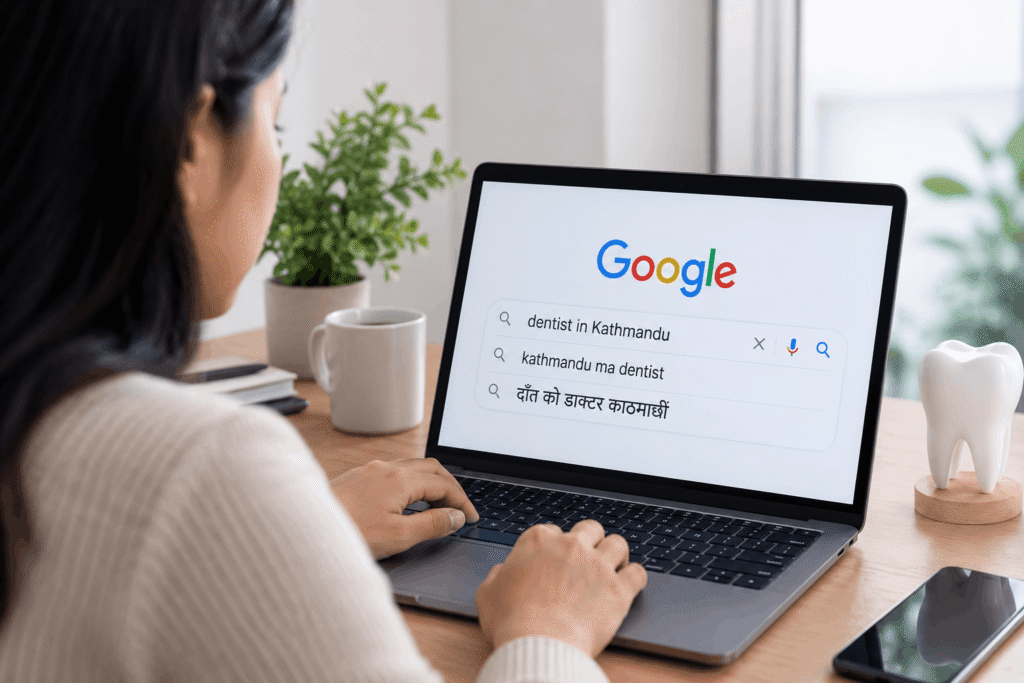
SEO in Nepali, not just English
This is the gap I find in almost every audit, and none of the pages you’ll compare me against mentions it at all.
People here search in three ways for the same thing: English, Nepali script, and Roman-Nepali. Someone looking for a dentist types “dentist in Kathmandu”, “kathmandu ma dentist” and “दाँत को डाक्टर काठमाडौं” depending on who they are and what keyboard they’re on. If your keyword plan only covers the English third, you’re absent from the rest of your own market and nobody has told you.
The tell is usually already in your Search Console: a site picking up stray impressions for Roman-Nepali queries nobody planned for, landing on pages that weren’t written for them. Bilingual research is part of every engagement here, not a line item you pay extra for.
Kathmandu isn't one market — and Nepal isn't only Kathmandu
A strategy that treats the valley as one place misses most of it. What someone searches in Thamel is not what they search in Kalanki.
- Thamel, Lazimpat, Boudha — hotels and trekking. Largely English, largely foreign, searched weeks ahead, sharply seasonal. An October arrival is won in July.
- New Baneshwor, Putalisadak, Bagbazar — consultancies, coaching centres, IELTS classes, law and accounting offices. Fiercely competitive, and with far more Nepali and Roman-Nepali search than most owners expect.
- New Road, Asan, Sundhara — retail. People search the product, not the shop: “iphone price new road”, not the name of your store. Product pages rank; a brochure site doesn’t.
- Patan, Jhamsikhel, Sanepa — cafés, clinics, gyms, studios. Map-pack territory, where your photos and opening hours do as much work as the website.
- Kalanki, Balaju, Koteshwor — hardware, workshops, transport, wholesale. Mostly no online presence at all, which means the first business here to set one up properly owns those results for years.
Outside the valley, SEO services in Nepal change shape again. Pokhara and Chitwan live on seasonal international search, so content and listing updates have to be planned around the trekking and travel curve. Birgunj benefits most from bilingual content and a listing built for cross-border buyers. Biratnagar and Butwal are largely greenfield — foundational work delivers disproportionately there compared with a saturated Kathmandu category. How this plays out by industry is a separate question again.
What you keep if you stop working with me
Everything. The website, the content, the technical changes, the links, the Google Business Profile, Analytics, Search Console, the ads account. All of it in your name from day one, so there’s nothing to hand back that wasn’t already yours.
I spell it out because almost nobody in this market does. Ask whoever you’re considering what happens to your website, your content and your Google listing when the invoices stop. If the answer is vague, the work is being rented to you rather than built for you.
Who does the work
I do — every account, all of it, from the first audit to the report that lands at the end of each month, and you have my mobile number rather than a ticket queue. What you get from IT Arrow Pvt. Ltd. being a registered company is a proper invoice, a PAN number for your books and a real legal counterparty; what you don’t get is an account manager between us. More about me and how I ended up doing this.
Who I'd turn away
If you need customers this month rather than this quarter, SEO is the wrong tool and I’ll say so — Google Ads is the honest answer. If your site is slow, badly structured and you can’t edit a word of it yourself, fix that before spending anything on rankings.
And occasionally the audit comes back saying the search side is fine. The traffic is arriving; the enquiries aren’t, because the phone number is buried three scrolls down, or the pricing is wrong for the market, or the page answers a question nobody asked. Selling that business a monthly retainer would be charging them for the wrong repair, so I don’t.
Let’s Grow Your Business
Need more traffic, leads or sales? Tell me what you’re working on and I’ll recommend the right approach — SEO, Google Ads or website improvements.
Questions I get asked
What does the monthly report actually look like?
Two pages, written not exported. The top half is what I changed and why. The bottom half is what happened: enquiries, calls from the Google listing, and the handful of search positions that matter to your revenue rather than the fifty that flatter the report. If a month was slow I say so and explain what I’m doing about it. You should be able to read it in four minutes and know whether your money worked.
Do you work outside Kathmandu?
Yes. I provide SEO services in Nepal generally, not just the valley — Pokhara, Biratnagar, Birgunj, Chitwan, Butwal and beyond. The strategy changes with the market; the process doesn’t. I’ll also tell you honestly if yours is a market where SEO won’t pay back quickly.
Can you work on my existing website?
Usually. A rebuild is the most expensive answer to most problems, and a site that loads at a reasonable speed and lets you edit a page yourself rarely needs one. What it normally needs is structure — one page per thing you sell instead of one page carrying six. The audit will tell you which situation you’re in, and I’d rather lose a website build than sell you one you don’t need.
Can you guarantee a #1 ranking?
No, and neither can anyone else — nobody controls Google’s algorithm. You’ll see guarantees offered in this market; when you look closely they usually apply to a phrase nobody searches for. What I’ll commit to is a transparent process, honest reporting, and work that stays yours.
What if my business runs on Facebook?
Facebook reaches people who already follow you. Google reaches people who need what you sell right now and have never heard of you. If most of your new customers could come from someone searching “near me”, it’s worth doing — and it doesn’t need to be a big site. A fast five-page site plus a properly worked Google listing outperforms most of what’s ranking in Kathmandu today.
How is this different from hiring an agency?
You deal with the person doing the work instead of the person managing it, with the accountability of a registered company behind it. The trade-off is honest: I take on the number of clients I can service properly, so occasionally I’ll tell you I can’t start for a few weeks. That’s a better answer than saying yes and passing your account to somebody junior.
Start with the free audit
Send me your website and I’ll go through it and your Google listing myself, by hand. Within two to three business days you’ll get a plain-language summary of the things that would actually make a difference. It costs nothing, there’s no obligation, and if the answer is that you only need two small fixes, that’s what I’ll tell you.
See what the free SEO audit includes or get in touch and tell me what isn’t working.
- Kathmandu, Nepal
- +977 9801060076
- [email protected]
- Mon–Fri, 8:00 PM – 7:00 AM NPT