
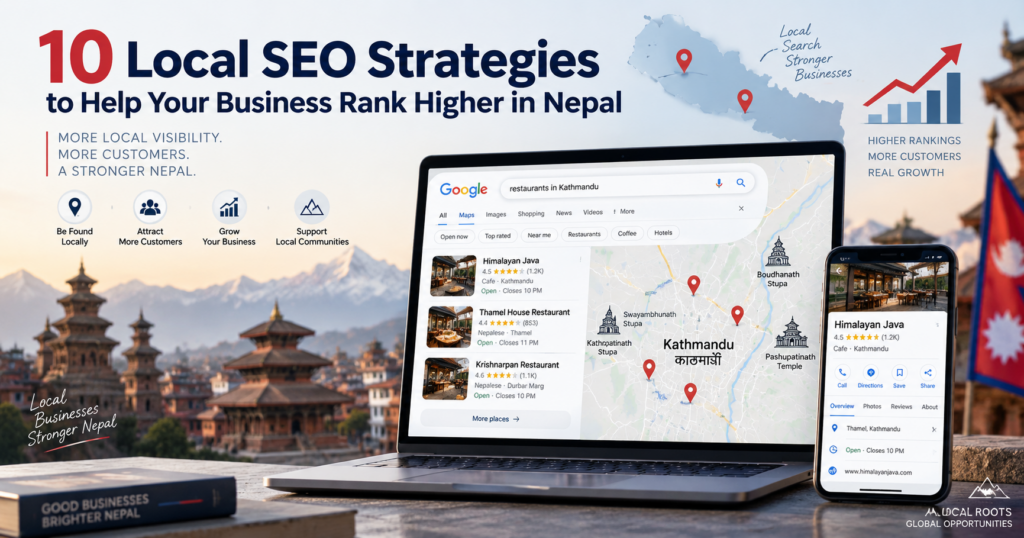
Most local SEO advice you’ll read was written for a market with numbered streets, a mature review culture and fibre broadband. Nepal has none of those, and a fair amount of standard advice quietly stops working here.
These are the ten things that actually move the needle for a business in Kathmandu, Pokhara, Biratnagar or anywhere else in the country — and, where it matters, the Nepal-specific reason the usual version of the advice doesn’t apply.
What local SEO actually means here
Local SEO is the work that gets your business shown when someone nearby searches for what you sell — in Google Search, and more importantly in Google Maps.
The difference from ordinary SEO is intent. Someone searching “electrician in Kalanki” at 9pm isn’t researching. They have a problem and they’re going to call one of the first three results. That’s why, for most Nepali businesses, local SEO produces enquiries faster and cheaper than anything else you can do online.
1. Get the Google Business Profile right, then keep it alive
This is not the first of ten equal steps. For a local business in Nepal, it’s the one that produces the first calls, often before your website ranks for anything at all.
Three things people get wrong here specifically:
Verification. Postcard verification is the default and it’s unreliable outside city centres, where addresses are descriptive rather than numbered. If the postcard option is failing you, look for video verification — you record a short walkthrough showing your signage, your premises and your equipment. It is usually faster in Nepal than waiting on post.
The category. Your primary category does more to decide which searches you appear in than anything on your website. Pick the most specific one that fits, not the broadest. “Carpet cleaning service” will beat “Cleaning service” for the searches that matter, and you can add the broader one as a secondary.
Service area or address. If customers come to you, publish the address. If you go to them — a plumber, an electrician, a cleaning company — set it up as a service-area business and list the areas you actually cover. Listing half the valley when you only work in Lalitpur will cost you.
Then keep it active: photos that are actually yours, current hours including festival closures, and a post now and then. Google’s own documentation on profile setup is worth twenty minutes.
2. Target the way Nepalis actually search — in three languages
This is where most local SEO work in Nepal is half-finished, and it’s the single biggest opportunity on this list.
Your customers search in three ways, often for the same thing:
- English — “dentist in Kathmandu”
- Devanagari — “दाँत को डाक्टर काठमाडौं”, “सस्तो ल्यापटप काठमाडौं”
- Roman-Nepali — “kathmandu ma dentist”, “sasto hotel pokhara”
Most keyword research done in this country covers the first and ignores the other two. If that’s your situation, you’re invisible for a meaningful share of your own market and nobody has told you.
The second half of this is geography. “Dentist in Kathmandu” is one search. “Dentist in Baneshwor”, “dentist in Chabahil”, “dentist near Bir Hospital” are three more, they’re less competitive, and they’re closer to how people actually think. Nepalis navigate by tole and landmark, not by city. Your pages should too.
Put these where they belong — page titles, headings, the body copy, image alt text — and stop there. Repeating a phrase until it reads badly hasn’t worked for a decade.
3. Freeze one version of your address and never change it
NAP consistency — name, address, phone appearing identically everywhere — is standard advice. What’s not standard is how hard Nepal makes it.
Most addresses here have no street number. Tole names get spelled several ways in English: Baneshwor, Baneshwar, Banesvor. Ward numbers change. Two people in the same office will write the address two different ways.
So pick one exact version, write it down, and use it as the only version — on your website, your Google Business Profile, your Facebook page, every directory, every invoice. Something like:
Sunrise Dental Care, Ward 10, New Baneshwor, Kathmandu 44600
Same spelling, same punctuation, same phone format, every time. Google is matching strings. It can’t know that Baneshwor and Baneshwar are the same place.
4. Ask for reviews in person, follow up on Viber
Reviews are a genuine ranking factor and they’re the first thing a customer reads. The problem in Nepal is that almost nobody leaves one unprompted — the habit simply isn’t there yet.
What works:
- Ask at the moment of satisfaction, in person, when the job is finished and the customer is happy. Not by email three days later.
- Send the short review link on Viber or WhatsApp, because that’s where your customers actually are. Google gives you a short link in your profile — use it, don’t make anyone search for you.
- Reply to every review, including the bad ones, in the language it was written in. A calm reply to a complaint convinces more readers than the complaint discourages.
- Never offer a discount for a review. It’s against Google’s rules and the reviews can be removed along with your credibility.
Ten honest reviews collected over three months will do more for a Kathmandu business than most of what agencies sell as local SEO.
5. Write about your area, not about your industry
“Publish helpful local content” is advice everyone gives and almost nobody acts on, because it’s not clear what to write.
For a Nepali business, the content that earns local relevance is usually one of these:
- A page for each area you serve — not a list of areas on one page, an actual page about working in that area
- Seasonal content that matches real demand — trekking season for a hotel, Dashain and Tihar for retail and delivery, monsoon for repairs and waterproofing, exam season for consultancies
- The questions you answer on the phone all day. Whatever customers ask you five times a week is a page, and it will rank because nobody else has bothered to write it down
One genuinely useful page about your neighbourhood beats ten generic blog posts about “the importance of digital marketing”.
6. Build for a phone on mobile data, not for your laptop
Most local searches in Nepal happen on a phone, on mobile data, often on a connection that is not fast. A site that loads comfortably on office wifi can be unusable on 4G in Kalanki at 6pm.
The things that matter most, in order:
- Image weight. This is nearly always the problem. A 2 MB hero photo is a wall your customer has to climb before they see anything.
- A visible click-to-call button on every page, above the fold. For most local businesses here, a phone call is the conversion — not a form.
- Readable text without zooming, and tap targets a thumb can hit.
I’ve written separately about why website speed matters and how to fix it.
7. Build citations that a human would actually use
A citation is any online listing of your business name, address and phone number. They help Google confirm your business is real and where it says it is.
The advice you’ll usually see is to submit to hundreds of directories. Don’t. Most global directory lists are useless here and a good number of the automated submission services will get your details wrong, which is worse than not being listed at all.
Prioritise instead:
- Your own Facebook page — for many Nepali businesses this is the second most-visited listing after Google, and the address on it is often wrong or missing
- Your industry association, if you belong to one, and your local chamber of commerce
- Nepali directories your customers actually use — [insert the two or three you use and can vouch for]
- Supplier and partner sites that list their stockists or service providers
Ten accurate listings beat two hundred sloppy ones. Every one of them must carry the exact address string from point 3.
8. Earn local links the slow way
Links from other Nepali websites are the hardest part of local SEO here and the reason older domains still outrank better pages.
There’s no shortcut worth taking. Anyone selling you “500 backlinks a month” is selling automated directory and comment spam, which does nothing at best and needs cleaning up at worst.
What actually works is slow and manual: sponsoring a school or community event and getting listed on the page; being quoted in a local news story; a supplier or partner linking to you; an association membership page; a genuinely useful resource that other people in your industry reference. A handful of real links a year will outperform anything you can buy.
9. Fix the technical basics once, properly
Local SEO fails quietly when the site underneath it can’t be crawled or understood.
The short list: one H1 per page, a title and meta description written for each page rather than auto-generated, HTTPS, a sitemap submitted in Search Console, no important pages accidentally set to noindex, and LocalBusiness structured data carrying your name, address, phone and hours.
That last one is worth doing properly — it’s how you hand Google your business details in a format it can’t misread. If you’re not sure what state your site is in, that’s exactly what a free SEO audit is for.
10. Track the three numbers that mean something
Most local SEO reporting drowns you in metrics that don’t connect to your business.
For a local business in Nepal, three numbers tell you almost everything:
- Calls from your Google Business Profile. Google counts these for you. This is the closest thing to a direct measure of whether local SEO is working.
- Direction requests. Someone asking Google how to get to you is someone about to walk through your door.
- Enquiries you can trace to search — ask every new customer how they found you, and write it down. It’s unglamorous and it beats any dashboard.
Rankings and traffic are useful context. They are not the point, and a report that shows only those two is hiding something.
The mistakes I see most often in Nepal
- A Facebook page instead of a website. Facebook reaches people who already follow you. Google reaches people who need you right now and have never heard of you.
- A Google Business Profile claimed once and never touched again — wrong hours, no photos, no replies to reviews.
- Three different versions of the address across the website, the profile and Facebook.
- English-only keyword work in a market where a large share of searches aren’t in English.
- Buying backlinks, then paying someone else to clean them up.
- Giving up at month two. Local SEO compounds. Most of the businesses that “tried SEO and it didn’t work” stopped before anything had a chance to.
Frequently asked questions
How long does local SEO take in Nepal?
A completed Google Business Profile and the technical basics can move things within weeks — sometimes days for the map pack in a less competitive area. Meaningful organic rankings in a competitive Kathmandu category usually show at three to four months and keep building past six.
Can I do local SEO without a website?
Partly. A well-run Google Business Profile alone will get a small business real calls, and for some businesses that’s enough to start. But you’ll be capped: you can’t rank for the dozens of specific searches a website covers, and you’re building on land you don’t own.
Does my Google Business Profile need a physical address?
No. If you travel to customers, register as a service-area business and list the areas you genuinely cover. You’ll be asked to verify the address but it won’t be shown publicly.
Should my website be in Nepali as well as English?
The whole site, usually not. But the searches are bilingual, so your keyword research must be — and a few key pages written for Nepali-language searches are often worth more than a full translation nobody reads.
Do I need to pay someone, or can I do this myself?
Points 1, 3, 4 and 5 you can do yourself, and a business that does only those will be ahead of most of its competitors in Nepal. The technical layer and competitive keyword research are where outside help earns its money.
Is local SEO only for small businesses?
No — any business serving customers in a specific place benefits, including multi-location companies, which need a separate optimised page and profile for each branch.
Where to start
If you do nothing else from this list: claim and complete your Google Business Profile, fix your address so it’s identical everywhere, and ask ten happy customers for a review. That’s a weekend of work and it will put most Nepali local businesses ahead of their competitors.
If you want to know what your own site needs before spending anything, I do a free SEO audit — I look at your site and your Google listing manually, and within two to three business days you get a plain-language summary of the three to five things that would actually make a difference. If the answer is that you only need two small fixes, that’s what I’ll tell you.
You can also read more about how I approach local SEO, or what a Google Business Profile does for a local business.
2 Responses