
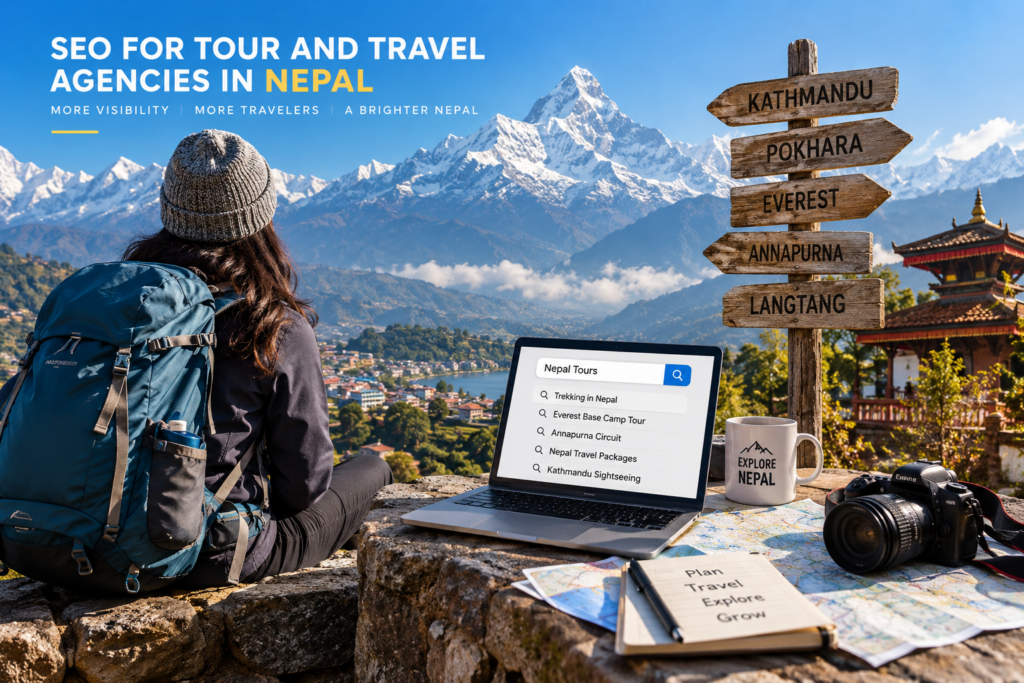
Picture two travel agencies in Kathmandu, a short walk apart. One is in Thamel. It sells Everest Base Camp and the Annapurna Circuit to people in Melbourne and Munich. The other is in Kamaladi. It sells Dubai packages for Dashain, Bangkok–Pattaya honeymoons and air tickets to Doha, and its customers find it on Google Maps and then message on WhatsApp.
Search “SEO for travel agency in Nepal” and almost every guide you find is written for the first agency. The second gets advice about “targeting international travellers” that has nothing to do with its business.
This guide is for both. I’ll show you how the two differ, what actually brings direct bookings for each, what it costs in rupees, how long it takes, and the cases where I’d tell you to keep your money.
A quick word on where this comes from. I’ve spent more than eight years building websites and doing SEO for businesses in Nepal, and travel, trekking and hospitality are among the industries I work with most. Everything below is what I check first when a travel agency asks me why its website isn’t bringing in bookings.
The short answer
- Inbound agencies win with detailed trek and tour pages: real prices, real guides, real photos, and proof that you’re a licensed operator. Expect 6–12 months before Google sends a steady flow of enquiries.
- Outbound and ticketing agencies win on Google Maps and on destination pages priced in NPR, written for how Nepalis actually search, which is often in Nepali or Roman-Nepali. Results usually come faster, in 3–6 months.
- Both lose bookings by not counting WhatsApp conversations. If you can’t see where a booking came from, you can’t tell whether SEO is working.
- Neither should start SEO if they need bookings this month. That’s what ads are for.
What SEO for a travel agency in Nepal actually involves
Forget the textbook definition for a minute. For a Nepal travel business, SEO has one job: getting people who are already planning a trip to find your page and contact you directly, rather than booking through a platform that takes a commission, or through the agency next door.
Everything else, including keywords, blogs, links and schema, only matters if it moves that number.
Inbound, outbound or both: work this out first
The first thing I ask a travel agency is who actually pays them. The answer changes the whole strategy.
| Inbound (tours and treks in Nepal) | Outbound (Nepalis travelling abroad) | |
|---|---|---|
| Who’s searching | Travellers from India, the US, UK, Europe, Australia and China | Nepali families, couples, students and workers |
| What they type | “annapurna circuit 14 days”, “nepal tour package from delhi” | “dubai package from nepal”, “thailand ghumna kati kharcha” |
| Language | English, plus Hindi-English for Indian travellers | English, Roman-Nepali and Devanagari |
| Your real competition | Overseas agencies, OTAs, other Thamel operators | Other Kathmandu agencies and Facebook pages |
| The page that earns money | The individual trek or tour page | Destination package pages and your Google Business Profile |
| When demand peaks | Spring (Mar–May) and autumn (Sep–Nov) | Dashain and Tihar, winter holidays, wedding season |
| Where the sale closes | Email and WhatsApp, over weeks | WhatsApp, Viber or at your counter, within days |
If you do both, which many agencies do, treat them as two sections of the site with two keyword lists. A single “Our Packages” page that lists Upper Mustang next to Bangkok–Pattaya ranks for neither.
What SEO replaces in your budget
Most tour and travel agencies in Nepal get customers from three places: word of mouth, boosted Facebook posts, and OTAs or foreign partner agents who take a cut.
SEO won’t replace word of mouth. What it replaces is the money you keep paying the other two. A boosted post stops working the day you stop paying. An OTA booking gives away part of your margin, and the platform usually keeps the customer’s details. A page that ranks for “manaslu circuit trek with local guide” keeps sending enquiries every season, and the customer who books through it is yours for their next trip too.
That’s the whole business case for direct bookings.
Travel agency SEO in Nepal starts with how your customers actually search
Most keyword research goes wrong here. People plug “travel agency Nepal” into a tool, see a decent number, and build the whole site around it. But the people typing that are mostly other agencies, job seekers and students writing assignments. Real customers search for the trip.
Inbound: people search for the trip, not the agency
A trekker in Germany doesn’t search “best travel agency in Nepal”. They search:
- “everest base camp trek cost”
- “manaslu circuit permit”
- “annapurna base camp in 7 days”
- “is upper mustang worth it”
- “kathmandu pokhara chitwan tour 8 days”
Each of those is a page you could own. The agency that answers the question properly, with the permit fees, the days, and what happens when it snows on Thorong La, gets the enquiry.
Indian travellers need their own pages
India is Nepal’s largest source market by a wide margin. According to the Nepal Tourism Board’s figures for fiscal year 2025/26, 311,531 of about 1.2 million foreign visitors came from India, roughly one in four and nearly three times as many as the next country, the US. Yet most Nepali travel SEO guides barely mention them. They search differently from Western trekkers:
- “nepal tour package from delhi”
- “muktinath yatra package from gorakhpur”
- “pashupatinath darshan tour”
- “kathmandu pokhara package for family”
Indian nationals don’t need a visa for Nepal, and many come by road through Sonauli–Bhairahawa or Raxaul–Birgunj. So a page for them should quote prices in INR, show a road itinerary as well as a flight one, and make phone contact easy, because many would rather call than fill in a form. A single “Nepal Tours” page written for Europeans misses all of that.
Outbound: English, Roman-Nepali and Devanagari
This is where most agencies in Kathmandu leave the most money on the table. A Nepali planning a trip abroad might type any of these:
- English: “dubai package from nepal”, “thailand tour package price in nepal”, “schengen visa appointment kathmandu”
- Roman-Nepali: “dubai ghumna kati kharcha lagcha”, “bali honeymoon package nepal bata”
- Devanagari: “थाइल्याण्ड घुम्न कति खर्च लाग्छ”, “दुबई प्याकेज”
Keyword tools barely register the last two, so almost nobody writes for them. That’s exactly why they’re worth writing for: less competition, and the person typing “kati kharcha lagcha” (how much will it cost) is already close to booking. A short section on your Thailand page that answers the question in Nepali, with a clear NPR price, can pick up those searches without a separate site. I explain the three-language approach in more detail in my guide to local SEO in Nepal.
One search, one page
The most common mess I find on Nepali travel websites is four pages chasing the same search: “Dubai Tour”, “Dubai Package”, “Dubai Holiday Deal” and a blog post called “Visit Dubai”. Google can’t tell which one matters, so none of them rank well.
Give each search intent one home:
| What someone searches | The page that should rank |
|---|---|
| “everest base camp trek 14 days” | The EBC trek page: itinerary, price, dates |
| “best time for everest base camp” | A blog guide that links to the trek page |
| “nepal tour package from delhi” | An India-specific tour page with INR prices |
| “dubai package from nepal” | The Dubai destination page |
| “uae visit visa for nepali” | A visa support page |
| “travel agency kathmandu” | Your homepage plus your Google Business Profile |
If you already have duplicates, merge them into the strongest one and redirect the others to it with a 301 redirect. Don’t just delete them.
Package pages: where bookings are won or lost
On a travel website, the blog brings people in, but the trek or package page decides whether they contact you. On most Nepali travel sites it’s the weakest page on the site.
The copied itinerary problem
Search “everest base camp trek” and open a few Nepali operators on page one. You’ll notice how similar the day-by-day itineraries are, sometimes word for word. Years of agencies copying each other’s content have left dozens of near-identical pages.
Google has no reason to rank the twentieth copy of the same text. What makes your page worth ranking is what only you can write:
- Who leads the trek: the guide’s name, a photo, how many seasons they’ve guided in the Khumbu.
- What you do when things go wrong: in peak season, Lukla flights usually leave from Manthali in Ramechhap rather than Kathmandu, which means a very early drive of four to five hours. Say so on the page, explain the drive, and tell people who pays for the extra night if the flight is cancelled. That one paragraph shows more experience than a thousand words of “breathtaking views”.
- Where guests actually sleep, and why you chose that teahouse in Namche.
- Your own photos: your groups, your guides, your jeeps. Not the same stock shot of Ama Dablam every other site uses.
What a package page needs
- A price. At least a “from” price, and for outbound packages, NPR per person. Say whether it’s twin sharing and what the single supplement is. “Contact us for price” sends people to the next tab.
- Departure dates, or “private trip, any date” if that’s how you work.
- What’s included and what isn’t, as a plain list: flights, visa, insurance, meals, permits, tips.
- Cancellation and refund terms. This is the question that stops a traveller from sending a deposit. Answer it before they ask.
- A WhatsApp button with a pre-filled message that names the package, e.g. “Hi, I’m interested in the Langtang Valley Trek (8 days)”. You’ll know which page every enquiry came from. The link is just wa.me/ followed by your number with the 977 country code, then ?text= and your message, so no plugin is needed.
- FAQs based on real conversations. Scroll back through your WhatsApp chats and put the ten most common questions on the page.
Keep seasonal pages; don’t rebuild them
A lot of outbound agencies make a new “Dashain Dubai Offer 2026” page every year and let last year’s go dead. Build one page, “Dubai package for Dashain”, and update the price and dates each year. A page that has been live and linked to for three years will outrank anything you publish the week before the festival.
Google Business Profile for a travel agency in Kathmandu
If you run an outbound or ticketing agency, this matters more than your website. Searches like “travel agency Kathmandu”, “air ticket near me” and “visa service kamaladi” are decided on Google Maps, and most of the profiles I check in Thamel, Kamaladi, Durbarmarg and Putalisadak were claimed years ago and never touched again.
- Primary category: “Travel agency”. Add secondary categories such as “Tour operator” or “Tour agency” only if they describe what you actually do, and pick them from Google’s own list rather than guessing.
- Business name: exactly as it appears on your registration. Putting “Best Tour Packages Nepal” into the name breaks Google’s guidelines and is one of the quickest ways to get the profile suspended.
- Photos: the office front, the counter, your team. Nepali customers who are handing over a passport want to know you exist.
- Reviews: ask when a customer comes back from a trip happy, not when they book. Send the review link on WhatsApp. It takes them thirty seconds. Five honest reviews a month for a year will put you ahead of most agencies in your area.
I’ve written separately about what a Google Business Profile actually does and why most of them stall.
Trust signals Nepali travel websites keep hiding
Picture someone in Toronto about to send a deposit for a USD 1,500 trek to a company they found on Google an hour ago. They’ll look for any reason to stop. Generic SEO guides call this “E-E-A-T”. For a tour and travel agency in Nepal it’s much more concrete. Show:
- Your Department of Tourism licence number, in the footer and on the About page.
- Company registration and PAN/VAT number.
- Memberships such as NATTA or TAAN, and IATA if you issue tickets. Only list the ones you actually hold. People can check.
- Your team, with real names and faces, especially guides.
- Your office, with a photo and the address, so people know you’re more than a Facebook page.
- How payment works: accepted cards, the bank transfer steps, what the deposit covers and when the balance is due.
None of this takes long to add. On many sites I audit, the licence number is sitting in a PDF nobody can find.
Technical fixes that matter on a travel website
Travel sites grow fast: forty treks, twenty destinations, departure dates, a blog. The technical problems grow with them. These are the ones I find most often.
- Slow pages on mobile data. Your outbound customers are on Ncell or NTC data. Your inbound customers might be opening your page on hotel Wi-Fi in Namche. A trek gallery with thirty 4 MB phone photos won’t load. Compress images and lazy-load galleries. See why speed matters.
- Dead departures and retired packages. Don’t delete a page that gets traffic. Update it, or redirect it with a 301 to the closest trip you still run.
- The same trek at three URLs. WordPress tour plugins often create /trip/ebc/, /destination/everest/ebc/ and a filtered version of the same page. Set a canonical tag so Google knows which one counts.
- Schema that doesn’t match the page. Mark up your business as a TravelAgency and make sure the name, address, phone number and prices in the markup match what’s visible on the page.
My technical SEO checklist covers the rest.
Keep your pages current when rules change
Nepal’s trekking rules, permit fees and flight arrangements change, sometimes with little warning. In April 2023, Nepal started requiring foreign trekkers in national parks and conservation areas to be accompanied by a licensed guide. The Everest region’s local municipality publicly disputed the rule, and travellers spent months searching for answers: “can I trek solo in Nepal”, “is a guide mandatory for everest base camp”.
It hasn’t stopped since. The TIMS card now works differently in the Everest, Annapurna and Langtang regions, and permit pricing for areas like Upper Mustang has been revised. A trek page that still quotes the old rules isn’t just outdated. It tells the reader you aren’t paying attention.
Put a “last updated” date on every trek page, and check permits, fees and rules with the Department of Tourism or the Nepal Tourism Board before each season. It’s the cheapest content work you’ll ever do, and it tells both travellers and Google that the page is maintained.
Plan content around two calendars
Publish or refresh pages two to three months before people start searching, not during the rush.
| Your business | Update pages by | For searches during |
|---|---|---|
| Inbound trekking | December–January | Spring season (March–May) |
| Inbound trekking | June–July | Autumn season (September–November) |
| Outbound | July–August | Dashain and Tihar |
| Outbound | September–October | Winter holidays and wedding season |
An agency that updates its Dubai page the week before Ghatasthapana is already too late.
Travel SEO in Nepal and AI search
More travellers now ask ChatGPT, Gemini or Google’s AI Overviews questions like “which company should I book the Manaslu Circuit with?” before they ever open a website. Nobody can promise you a spot in those answers, and I’d be wary of anyone who does.
In my experience, though, the pages that tend to get pulled into AI answers are the same pages that rank well anyway: clear facts (price, number of days, permits needed), a business name that’s consistent everywhere online, and real reviews on Google and TripAdvisor. If your package pages follow the list above, you’re already doing most of what travel SEO in Nepal needs for AI search.
How to know if it’s working: count bookings, not visitors
Most travel agencies I audit have Google Analytics installed and still can’t say how many bookings came from Google. That’s not their fault. The bookings happen on WhatsApp, and Analytics can’t see inside WhatsApp.
Track three numbers instead:
- Website enquiries on WhatsApp and Viber. The pre-filled message on each package page tells you exactly which page sent them.
- Calls and direction requests from your Google Business Profile. These are in the profile’s Performance section.
- Bookings where the customer found you on Google. Ask every new customer “how did you find us?” and keep a simple sheet. It’s low-tech, and it’s the most honest number you’ll have.
If those three go up over six months, SEO is paying off. If only traffic goes up, it isn’t.
Not sure where your agency stands on any of this? A free SEO audit will tell you in about three days.
What travel agency SEO in Nepal costs
These ranges follow my full breakdown of SEO prices in Nepal, adjusted for how travel sites usually work:
| Type of agency | Typical monthly range | What drives the cost |
|---|---|---|
| Kathmandu outbound or ticketing agency, mostly local customers | NPR 20,000–35,000 | Google Business Profile, 10–20 destination pages, Nepali and Roman-Nepali keywords |
| Inbound operator with 10–20 treks and tours | NPR 35,000–60,000 | International competition, regular content, rewriting itineraries |
| Inbound operator with 50+ trips, several source markets, or a separate India section | NPR 60,000+ | Hundreds of URLs, technical clean-up, link building |
Two costs rarely show up in a quote: rewriting copied itineraries, and getting real photos from your guides. Ask any provider whether those are included. If you’re comparing providers, my guide on how to hire an SEO expert in Nepal lists the questions worth asking.
How long SEO for a travel agency in Nepal takes
- Outbound agency focused on Kathmandu: Google Maps and local search usually start producing more enquiries within 3–6 months.
- Inbound operator: 6–12 months for competitive treks. Everest Base Camp and the Annapurna Circuit are among the hardest searches in Nepali tourism. Less crowded trips like Tsum Valley, Makalu Base Camp or Kanchenjunga have far less competition and often move faster, which is a good reason to start with them.
When I’d tell you not to spend on SEO yet
- You need bookings this season. SEO won’t arrive in time. Google Ads can. If you’re torn, here’s how I think about Google Ads vs SEO.
- You resell other operators’ trips and add nothing of your own. You’d be competing for the same search against the company that actually runs the trek.
- Your website can’t be edited without calling a developer. Fix that first. See website design.
- Nobody answers WhatsApp for six hours. SEO will bring enquiries, and they’ll book with whoever replies first.
Mistakes I see on almost every Nepali travel website
- Package pages with no price, and no reason to contact you except the price
- Itineraries copied from a competitor, typos included
- The same stock photo of Everest on thirty pages
- “Best Travel Agency in Nepal” stuffed into the page title and the Google Business Profile name
- Blog posts like “Top 10 Places in Nepal” that don’t link to a single trip you sell
- No licence number anywhere
- A new page every festival instead of updating last year’s
Frequently asked questions
Is SEO for a travel agency in Nepal worth it for a small agency? Yes, if you pick your ground. A small agency won’t outrank the big platforms for “nepal tours”, but it can own “tsum valley trek with local guide” or “dubai package from nepal for family”. Specific searches are where small agencies win.
What’s the difference between travel SEO in Nepal and SEO for other businesses? Three things: strong seasonality, competition from international OTAs, and customers spread across several countries and languages. The basics are the same, but where you put the effort isn’t.
Should I target foreign tourists or Nepali customers? Target whoever actually pays you. If it’s both, build separate sections. The two groups share almost no search terms.
Do I need to write in Nepali? If you sell outbound packages, yes: at least on your main destination pages and FAQs. If you only sell inbound, English is fine, and add Hindi-English phrasing on pages for Indian travellers.
Can I rank above TripAdvisor or the big booking sites? Rarely for broad terms. Often for specific ones, and those specific searches are where the people ready to book are.
Is Facebook enough for a travel agency in Nepal? Facebook is good at reaching people who already follow you. Google reaches people who are searching for a trip right now. Most agencies need both, but only one of them keeps working when you stop paying.
How long before I see bookings? Usually 3–6 months for outbound agencies and 6–12 months for inbound operators, depending on how competitive your trips are and how much work the site needs.
Where to start
You don’t need a big plan to begin. This week:
- Check which of your pages compete for the same search, and merge them.
- Add a price and a WhatsApp button with a pre-filled message to your three best-selling packages.
- Put your licence number in the footer.
- Fix your Google Business Profile category and name, and ask five recent happy customers for a review.
That’s the part of SEO for a travel agency in Nepal you can do yourself. For the rest, including keyword research in all three languages, fixing copied itineraries and the technical clean-up, start with a free SEO audit. I’ll review your site myself and tell you what to fix first, even if the answer is that SEO isn’t the right spend for you yet. You can also see how I work with travel and hospitality clients.
About the author
Prakash Kushwaha is an SEO consultant in Kathmandu and the founder and managing director of IT Arrow Pvt. Ltd., a registered Nepali company. He has spent more than eight years building websites, running Google Ads and doing SEO for businesses in Nepal and abroad, including travel, trekking and hospitality companies. He does the work himself, including keyword research in English, Nepali and Roman-Nepali. More about Prakash · Call or WhatsApp: +977 9801060076